Today while I was trudging to my first class through -14 degree Fahrenheit weather, I had an epiphany. Finding time to write in your busy daily schedule is a lot like trying to walk up an icy slope when you can’t feel your legs . . . or your feet . . . or really any of your lower extremities. For every step you take forward in clearing your schedule, it feels like you slide back two feet as more obligations slip in to take up time and space. Every time you feel like you’ve found sure footing grounded in a good idea or a brief flash of inspiration, it turns out it’s actually black ice and you go tumbling face first towards the ground and have to start back at square one again. Writing in your spare time is also like walking up an icy slope because everyone else is laughing at you, saying you’ll never make it, it’s too hard, you’ll just crash and fall and make a fool of yourself. But we keep climbing that slippery slope anyways. And you know what? Sometimes we can actually make it.
Today I don’t have any pithy remarks or wise advice to dispense. Today I just want to send out a little signal of encouragement to the aspiring writers of the world. Even though sometimes your task may seem impossible, the mountain of dirty diapers may seem to tower ever higher, and you may begin to believe you will spend the rest of your life doing the same types of drudgery day in and day out, think again. You have a choice: and that is to try, against all odds, and go ahead and write your story. If you never try you will never fail, but you will never succeed either, will you?
Saturday, December 12, 2009
Epiphany and Encouragement

Wednesday, December 9, 2009
Biographicality
I spent the last blog talking about some various other avenues you could pursue besides novel-writing, but I neglected one avenue that didn’t occur to me until today when I had the chance to sit down with my 88-year-old grandfather and have a nice long talk. How many times have you wished you could know a little bit more about your ancestors? When you hear those stories about pioneers crossing the plains or the first settlers of the “New World,” don’t you wonder for a moment what a day in their lives must have been like? Well, there’s nothing you can do about those long-gone relatives. Perhaps their stories have been lost forever. But there is something you can do today—write the biography of your older relatives. Not only will it be a keepsake of incalculable value to you, but just think of your posterity. What could these stories mean to them? In the half hour talk I had with my grandfather, he related to me at least half a dozen stories of a time I can barely fathom. To give you an idea of what sorts of stories and lessons we can glean from the older generation, read the following summary of a story which my grandpa related to me:
Bill Hulet was drafted into the army at the age of 21. He was called to begin his training exactly  three weeks after he married Betty Danks (my grandmother.) In his training, his superiors discovered his knack for learning languages and he was assigned to become an interrogator of German POWs. He landed in Europe a month after D-Day and his battalion followed behind the first wave of troops that swept through Germany. One night, a German soldier was brought before him who couldn’t have been more than 19-years-old. Bill began questioning him and soon discovered that the young man was a Mormon—Bill was a Mormon as well. And suddenly there, in the midst of all the commotion of the POW camp, those two soldiers of opposing sides found a moment of peace. Bill comforted the young German, counseled him to follow orders, and promised that after the war he would be allowed to return home. Bill never saw that German soldier again, but he had the feeling that there was a German mother somewhere who had been praying that her son would not lose his faith during his time at war. That night, her prayer was answered.
Monday, December 7, 2009
Thinking Creatively to Creatively Write
I know I’ve spent nearly all my time addressing the novelists of cyberspace on my blog so far, so this time I thought I’d step outside the box and talk to those of you who want to write creatively but don’t have the time or inclination to write the next great American novel.
So what else is there? The opportunities for writing are only limited by your own creativity. I have a friend who contacted the Idaho Game and Wildlife Service to see if he could write an article for them on the species of fish inhabiting Payette Lake. They liked his article so much that they contracted him to write another article about migratory bird patterns in Northern Idaho. Obviously he didn’t know anything about this topic, so what did he do? He researched, he made some phone calls, and he did a little sight-seeing. He learned a whole lot about an interesting new topic, and the best part of all: he got paid for doing something he loved to do.
Poetry is another avenue you could explore. Local magazines and newspapers sometimes have creative writing sections to which people can submit their writing for the pure joy of seeing their name in print.
Are you very involved in your child’s elementary school? Offer to help write articles for the monthly newsletter. Perhaps that doesn’t sound like the most exciting job in the world, but the more you write, the more experience you get and the stronger resume you create. Networking with educators could also bring you to the attention of the “higher ups.” With a little imagination, who knows what impact your small-article writing may have?

Saturday, December 5, 2009
The Chicago Manual of Style
If you’re going to be doing very much of your own editing, it would probably be a good idea to invest in a copy of The Chicago Manual of Style. In 2003 they came out with the 15th edition and it can be found at most bookstores. Just to warn you, editing knowledge doesn’t come cheap. The copy I bought cost $55 new, so it might behoove you to check on EBay or Craig’s List for a used one before you shell out that much cash.
So what’s so great about this manual that it costs so much? For your information, it contains 955 pages of guidelines on everything from using correct grammar to an enumeration of the functions of an epithet to a detailed list of an author’s vs. a manuscript editor’s responsibilities during the editing and publishing process.
Still not convinced this could be a handy book to have around? Here’s an excerpt from the section on the “Author’s Responsibilities:”
After a book manuscript has been accepted for publication, publishers usually require the electronic files for the work . . . in its latest version, often in disk form, along with two sets of hard copy (one may be a photocopy), which must correspond exactly to the electronic files submitted (Chicago Manual 59).
The rest of that section is full of other helpful hints for those who are serious about getting published and the rest of the book includes one of the most comprehensive guides to grammar usage available. I wouldn’t suggest it as a piece of light reading—and I mean that literally, the book weighs at least 3 lbs—but it is absolutely chalk full of invaluable advice for those of us who are attempting to write in our spare time.

Friday, December 4, 2009
The Forgotten Step
Many times, people forget that once you have a completed manuscript in front of you, your work is only half done. Editing and proofreading are two of the most important steps you must take if you truly want to be published some day. When editing, it’s more important than ever that you put yourself in the right mood because you must be able to critique yourself. Remember to be honest—that part where Jasmine and Gregorio are standing on the balcony and you go into great detail about the positioning of their hands and the intricate embroidery of their coats may sound poetic and descriptive, but is it really necessary for moving the story as a whole forward? And remember that day when you didn’t really feel like writing but you felt like you should type something up and you just glossed over their whole ten day journey to Paris? Well, it might be a good idea to go back and flesh that out a bit.
To be fair, I’ve included below an example of a “Before” and “After” selection of my own writing. Notice all the changes I made after one proofreading. There is still a lot more I could do to it, which is why multiple proofreadings are often necessary.
Before:
Mitch stared blankly out the window at the dirty street where a homeless woman scantily clothed in rags and with nothing on her feet was shuffling forward slowly, her back hunched. Almost as if she felt his eyes, she suddenly looked up at his window. She saw the pale, blonde American standing there and smiled a toothless smile. The young man turned away.
After:
Mitch stared vacantly out the window at the dusty alleyway, his eyes listlessly following the progress of an old, barefoot woman scantily clothed in rags as she shuffled forward slowly, her back hunched. Her pot belly swayed like a full sack of flour, bulging obscenely from beneath her tattered wrap. Almost as if she felt his gaze, she jerked her head up suddenly and stared at his window. She saw the young, pale American standing there and her dark eyes nearly disappeared into the mass of black wrinkles that wreathed her face as she smiled a wicked, toothless smile. With tears streaming silently out of his bloodshot eyes, Mitch drew in a deep breath, and turned away.

Thursday, December 3, 2009
The Writing Mood

There is more to writing than being good at coming up with ideas. It's easy to think that once you have been hit with that lightning bolt of inspiration that everything else will just flow smoothly from there. If you've ever reached this point in the writing process, however, you'll know this is not true. Usually around this point your child will barge into the office insisting you come see the finger painting project she's just completed using ketchup on the kitchen counter or that fidgety baby who's been taking a nap for an hour is starting to whimper in his crib. Writing is not a spontaneous activity. Words will not appear magically in your brain, drain down to your fingertips and flow out through the keyboard. You have to be in the right mental as well as physical mood in order to write.
So how do you capture that elusive mood in the midst of your busy day? First of all, if you're sitting at the computer and all you keep thinking about is the dishes piled in the sink or the carpet that's starting to look furry from not being vacuumed in three weeks, you'll probably end up writing a textbook on the drudgery of household cleaning. Get all of that done before you sit down to write so you can have a clear mind and a clean conscience. True, it's hard to get everything done all at the same time, but are there things that could be put off one more day that don't have to be done all at once? Don't overload yourself.
T
Wednesday, December 2, 2009
Idea Creation Part 3

Do you recall any special event which took place on your block or in your neighborhood when while you were growing up? (deaths, fires, accidents, illness/quarantines, etc.)
What is your greatest joy? Your greatest sorrow?
Describe the perfect autumn day. What would you do?
Describe a sound from your childhood. What was it? When did you hear it?
What does it bring to mind?
Do you like to go to the theater? The opera? The symphony?
Tell about your life as the children left home. What did you do with your
extra time?

Tell about your father—personality, characteristics, coloring, talents, temper, his role, etc.
Are there any notable people from your hometown?
Tell the words of a song from your childhood. What memories does it bring?
Do you like rainstorms? Why or why not?
Tuesday, November 10, 2009
Idea Creation Part 2
Another good idea for breaking writer’s block (and just a good way to focus on the positive aspects of life) is to keep a “Thankful Journal.” Set a goal so that every day you record 3-5 things your thankful for in a notebook or journal. This keeps an even more precise account of your every day life than a journal does because in a journal you’ll usually write about the big events and gloss over the every day miracles that take place. That’s where your “Thankful Journal”
• Stayed up late to make a banner and a cake for my roommate’s birthday.
• People admired my sweet rubix cube skills.
• My mom took me to get a make over and $30 cover up.
• Got random free cookies in the library with cream cheese frosting.
• The butterflies in my stomach as the time of the blind date approaches.
• Pancakes I made perfectly all by myself.
• Attending a jazzy Christmas music night.
• Having a “boring” night with my roommates.
• Real rain where I could use my umbrella.
• Holding a three-day-old infant and him falling asleep in my arms.
• Eating a chicken heart at a Brazilian restaurant.
• Going for a walk down my own private “duck alley.”
• The nice security guard with the salt and pepper hair who was “twice as friendly as Santa Claus with a tickle.”
What kinds of things can you be thankful for in your own life?
Friday, November 6, 2009
Idea Creation Part 1
The easiest things to write about are things you already know about. We all have had unique, individual experiences that have shaped our points of view and lend a flavor to our voices that no one else on Earth would be capable of duplicating. But how do we incorporate our experiences into our writing effectively? We can't always remember the things we've done, the places we've gone, and the people we've met. The answer sounds easy, but can actually take more time and effort than a lot of people are willing to commit: keep a journal. This is a lot like writing down the ideas you feel inspired with, but you're writing about the events of your own life. Fortunately for me, journal writing has never been too big of a chore. I've kept a journal since I was in second grade. Granted, there are some years when I was younger when i was lucky to get even ten entries written down, but looking back now is like looking through a window at myself at a younger age. My writing demonstrates my mental state and capacity at that time period and certainly exposes the topics I was preoccupied with. The following are some excerpts from those early entries that I've felt like could be food for thought in future writing ventures:
January 28, 2004
I'm 13 years old. We got a calico cat named Magic from our grandpa for Christmas. My room is a mess. I shave. I wear deodorant. I got a perm and a haircut at the beginning of the school year and I got my hair layered more recently. I am infatuated with Andrew Heikkila and I have a small crush on Jeffrey Barnes . . . I am the president of Cantabile Choir and I think I'm too fat . . . I want to go out on a date and dance with a boy. I want to have my first kiss.
July 9, 2005
June was a month packed full of excitement and fun for me. On June 14 at 4:30 a.m. my mom woke everyone up so we could catch a 6:30 a.m. flight at the airport, beginning our trip to Washington D.C. When we finally got to D.C. at 4:30 p.m. my first impression was of heat and humidity. We rented a car and wanted to see the Lincoln Memorial but had faulty directions and ended up at the Jefferson Memorial. The rest of the trip went better though . . . we later saw the U.S. Captiol, the Smithsonian of American History and Natural History, the National Archives, and the Library of Congress. At these places we saw the original Kermit the Frog, Dorothy's ruby slippers, the Hope diamond and lots of fossils, and the Declaration of Independence.
Included with this last entry were the brochures I picked up for Williamsburg, VA and the Washington Monument and my ticket for when we toured the U.S. Capitol. As you can see, journal writing not only allows you to remember important events in your life, but it also reminds you of experiences that might be interesting to write about . . . in your spare time.


Thursday, November 5, 2009
Using Your Resources
As I was researching material to include in my blog, I found myself reading article after article and thinking, "This is exactly what I've been talking about all this time. My followers need to see this." The following are links to articles and other blogs I found that give great hints and tips on how to write in your spare time. If you ever thought you were alone in your difficulties of following your dreams in spite of vastly over-packed schedules and endless commitments, think again.
Ezine Articles
http://ezinearticles.com/?How-to-Write-a-Book-in-Your-Spare-Time&id=2259881
A Far Away City - Martin Adams
http://afarawaycity.blogspot.com/2009/07/writing-full-time-in-your-spare-time-pt.html
Article Directory
http://www.abcarticledirectory.com/Article/Write-a-Children-s-Book-in-Your-Spare-Time-/663956
Telling it Like it is
http://www.tellinitlikeitis.net/2009/11/earn-extra-money-from-home-in-your-spare-time-freelance-writing-online.html

Monday, November 2, 2009
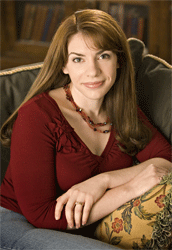
Stephenie Meyer
If there was ever a more famous success story of someone who got published from "writing in their spare time" than Stephenie Meyer, I have yet to hear of it. For the uninitiated, Stephenie Meyer is the best-selling author of the Twilight Series which includes the books Twilight, New moon, Eclipse, and Breaking Dawn. Two of these books have now been made into movies and they have each spent time on top the the New York Times Best-Sellers List. Prestigious as her name is now, however, she came from much humbler beginnings. I share this story so that those of you who think all great writers began like Mozart, who started composing at the tender age of 5, can think again.
Stephenie Meyer got her Bachelor's Degree in English from Brigham Young University (BYU) in Provo, Utah. She got married, had three kids, and established a comfortable life as a stay-at-home mom and may have continued in this way and passed on into the oblivion of nameless faces if she hadn't one night in 2003, at the age of 30, written down an idea she got from a dream. The idea so intrigued her that she began writing--in her spare time. According to her online biography, she "mostly wrote at night, after the kids were asleep so that [she] could concentrate for longer than five minutes without being interrupted." Despite the plethra of demands made on her time by three young children--from making breakfast to changing diapers to driving kids to and from swimming lessons--she finished her book in three months.
Maybe this biography describes you, and maybe it doesn't. One for sure thing is that Stephenie Meyer was leading a perfectly ordinary life up until the day she received from a publishing house the announcement that her book had been chosen for revision and publication. There are thousands more possible Stephenie Meyers in the world--all you really need is a good idea, a little spare time, and a determination to finish.
Saturday, October 31, 2009
Happy Halloween

- dark - shadowy, dim, gloomy, murky, bleak, pitch black, obsidian, ebony, impenetrable
- spooky - sinister, mysterious, threatening, evil, depressing, chilling, insidious, spine-chilling, unsettling, unearthly
- gross - repellent, disgusting, sickening, coarse, foul, nasty, awful, dreadful, uncouth, repugnant
- kill - assassinate, annihilate, slay, murder, slaughter, execute, destroy, exterminate, eradicate
- scream - yell, shout, shriek, cry, screech
- mean - evil, vicious, nasty, cruel, callous, malicious, despicable, shameful
- weird - strange, bizarre, cryptic, odd, peculiar, uncanny, eerie
- scared - terrified, horrified, frightened, afraid, petrified, anxious, timorous
- pain - anguish, agony, torture, suffering, distress, misery, woe, torment, angst
Friday, October 30, 2009
Everything I Need to Know About Writing I Learned in Third Grade
1. "i" before "e" except after "c" and when sounding like "a" as in "neighbor" and "weigh"
2. A poem means "Roses are red, violets are blue. Sugar is sweet, and so are you."
3. To get a good grade, write about a dog saving a baby or me and my sister learning not to fight.
4. "I" and "me" do not come first--put others first.
5. Not only do I have to color in the lines, but I have to write on the lines too.
6. Spelling counts--and I always thought it was math that counted.
7. "Their cat was there and now they're going to the store." Did I get that right?
8. I have to do more than fill up a page with words--they have to mean something.
9. Reading helps me write.
10. I'm going to have to write for the rest of my life.

Tuesday, October 27, 2009
Editor's Curse
My first editing teacher warned me from the beginning this would happen. The symptoms showed up slowly in the beginning. One day I was in the lounge of a hotel, waiting for my family to finish packing so we could check out, and I snagged a pamphlet advertising a Six Flags theme park. It had a fun, flashy front page and I idly flipped it open and began reading. After a minute, I noticed the way the headlines were formatted was inconsistent. I gave the offending elements a death glare for a long minute, then shrugged and turned to the right leaf. Next, however, I caught a misplaced semicolon. For some reason, that semicolon seemed entirely inexcusable to me. With one free hand, I groped around until I found a pen on the hotel's front desk, ignoring a puzzled glance from the receptionist, and with a swift swipe of my hand, crossed out the semicolon and substituted a comma. Satisfied, I replaced the pen and tucked the pamphlet back into the pile from whence it came.
The symptoms only got worse from there, though. Suddenly, no written word was safe from my wandering eye. Driving in the car, I found myself scrutinizing the tag line of every billboard. When reading magazines or the newspaper, I would come across an interesting sentence and start doodling a diagram of it in the margin. Before long I would check to be sure I had a red pen in my purse before leaving the house. I had begun waging a one-woman war on the writing of the world. It didn't take me long, however, to decide that there was no way I could win this war alone. There were just too many grammatical mistakes in the world for one person to effectively combat. That's when I finally remembered my editing teacher's advice from back in my freshman year of college. He'd explained to us back then about the Editor's Curse and described the symptoms. That's then I realized that I was tight in the grip of this dread disease and there was only one way to treat it: become desensitized. It sounds like a heartless, awful thing to say, but it is the cross we professional writers have to bear. We may try to educate the seething masses and do our part to change what we can, but I have long come to terms with the fact that we can't change the world all at once. It has to go slowly; one semicolon at a time.

Monday, October 26, 2009
Pay Attention
Today I decided to try out one of Nicole Mazzarella's suggestions for 
- "I've kissed 31 boys. Usually about one a week."
- "He was 4'10", talked with a voice like a parrot, and when he wasn't talking he was singing Michael Jackson songs."
- He grabbed a golf club and prepared to swing as the masked figures ran down the hall.
- "My mom is deaf but my grandma worked with her really hard so she could learn English. Being deaf has made her a very visual person."
- Gold leaves flapped wearily against a cold, iron sky.
- "It's all about the gold. 20 karat gold."
- "I used to tell my students we in the U.S. had the safest food supply in the world."
- Professor Lammons left work early on Friday to drive the sewing machine down to Salt Lake City.
- "They had to go to the hospital with $700 to pick up their baby."
- He was smiling and laughing right up until the moment his toe caught on the last step of the stairs and he tripped forward, sprawling, his books, papers, and even one of his shoes flying up into the air.
- "He bruised his thigh right down to the bone and now he walks like a bowlegged penguin."
- When she took the bandage off, there was a maroon, "v" shape left where the blood had pooled beneath her skin around the metal fastener.
- Her bottom lip was always slightly protruding and today that was accentuated by the forward thrust of her head, her hunched shoulders, though the view of her face was obscured by the short, brunette locks falling softly across her face.
- "Seventeen percent of school children are obese."
- She leaned down and pressed her lips to his broken hand, whispering, "There, I kissed it better."
- She walked into class snapping her fingers and bobbing her head, sending her chocolate curls bouncing like dozens of loose slinkies down her back.
Friday, October 23, 2009
To read, or not to read?
If you truly want to write well, you must also want to read well. Reading can help you create new ideas, broaden your vocabulary, and expose you to a vast amount of information. Reading "well," however, means more than just reading the newspaper or a magazine; it means you consciously seek out world-renowned literature that has been analyzed by scholars or other experts and is generally agreed to be "cultured" or "classic." Here's a list of my personal favorites. I have read each of the following books and have purposely chosen a wide variety of topics to include. The more you read, the more you know. The more you know, the m

- The Secret Life of Bees by Sue Monk Kidd
- The Good Earth by Pearl S. Buck
- Atlas Shrugged by Ayn Rand
- Pride and Prejudice by Jane Austen
- 1984 by George Orwell
- Catch-22 by Joseph Heller
- To Kill a Mockingbird by Harper Lee
- White Fang by Jack London
- Uncle Tom's Cabin by Harriet Beecher Stowe
- Jane Eyre by Charlotte Bronte
- One Day in the Life of Ivan Denisovich by Aleksander Solzhenitsyn
- The Little Prince by Antoine de Saint Exupery
- The Giver by Lois Lowery
- The Adventures of Huckleberry Finn by Mark Twain
- The Princess Bride by William Goldman


Monday, October 12, 2009
Technical Writing
A lot of times, people forget that there are more venues for writing than just creatively. Technical and professional writing may not get as much fanfare, but they definitely offer more reliable employment and a steady source of income. Recently, I hosted a panel of Technical Writers who participated in a Question and Answer discussion. Although my major is English and my emphasis is professional writing, I still learned a lot that I didn't 
For instance, did you know that a professional writer can get employment doing anything from formatting pamphlets, to proofreading brochures, to working with a team on the copy editing of manuals or novels, to acting as a language consultant for start-up or long-established companies? Specifically, one of the members of the panel has a job as a senior professional writer for the LDS church doing graphic design and java scripting for websites. His name is Tom Johnson and he maintains a blog called: www.idratherbewriting.com Another member works with a team of other technical writers on updating user's manuals for the military. One of my professors worked for the navy doing the same type of thing. If it's variety and spice you want, the possibilities in professional writing are endless.
Flexibility is another great advantage of professional and technical writing. You may be hired full-time permanently with benefits with a large company or corporation to keep all of their literature and instruction material correct and up-to-date. Another option is to work on a contract basis on one project. The length to complete a project might last between a few weeks to several months and occasionally may lead to long-term employment. Contract work pays more per hour, however, and allows you to decide when you want to work. The third option is free-lancing. This is the most flexible type of work, but it means you do a lot of marketing for yourself. This is ideal for social people who are good at networking and creating friendships. Free lance work might include applying for grants for libraries or proofreading newsletters or calendars. But no matter what line of technical or professional writing you end up in, work can be guaranteed. While sadly not all of us can become the next "Great American Author," all people with a degree in English (be it Bachelor's or Doctorate) can be assured of a chance to find stable, gainful employment.
Thursday, October 8, 2009
Tips on Writing from the Experts
One of the many advantages to attending college is my opportunity to rub shoulders with many great authors and professionals who have experience in the field I'm interested in and are perfectly willing to share some good advice. Today was the BYU-I Pre-Professional Conference for the College of Language and Letters. Two authors were flown in for the event: James Richardson, a poet and a professor of creative writing at Princeton, and Nicole Mazzarella, a novelist and a

James Richardson was the Keynote Speaker and he entitled his address, "All Work is the Avoidance of Harder Work." As he spoke to the congregation of students, it was clear to all by the glowing expression of his face and the delighted chuckle that occasionally bubbled into the microphone that he loved the subject of creative writing. His remarks were mainly addressed to aspiring poets, telling us that poets have the job of "thinking about stuff" and he warned that no one gets rich off of it. When he calculated all the days and months and years he'd put into his writing and compared that to how much money he's made, his paycheck came to about eleven cents an hour. But this was alright with him because he didn't do it for the money, he did it for the pleasure of it. Besides poetry, he is also the author of over 800 aphorisms--shorter even than a poem, these are one-liners that proclaim a profound message. Two of his own that he shared with us were, "Despair says, 'I cannot lift that weight.' Happiness says, 'I don't have to.'" and "No one ever writes a novel by accident."
Nicole Mazzarella expounded in her remarks on the latter aphorism of the above. Her talk was so chalk-full of incredible advice, I had a hard time writing it all down. Included below are some of the choicest tidbits for those of us who aspire to be writers but have not had a lot of official training and do not have a lot of extra time:

- Pay attention. Characters can emerge from people around you, random questions, and even stray comments. She gave an example of a friend's father who kept a box in the attic titled: "String too short to use." This immediately got her wondering what sort of person would keep a box like this--what life experiences would have prompted him to create such a box in the first place? These are the sorts of questions we must ask ourselves; the creative juices will take care of the rest.
- Create Space. You will never have more time to write than you have right now. Each season of life will have its demands and will always provide you with excuses not to write. This means that you must make the conscious decision to write today and then make time for it--whether that means staying up later or getting up earlier. Nicole told a story of a surgeon who said, "I'm going to write a book when I retire," to which an author replied, "Oh sure, and I'm going to become a surgeon when I retire."
- Be prepared. Keep notecards in your pocket and a notepad by the bed. You never know when inspiration will strike.
- Free Write. This means writing about the background of your characters--What is an average day in their lives like? What kinds of preferences do they have? You might do a lot of free writing that never goes into your story but it will help you realize that the character lives a fuller life than the moment we've stepped into.
- Commit. Develop a habit of regularly writing with and without a deadline and finish your book or other piece of work even if you feel it's not that great. You may fail a lot, but it will be good practice and that's the only way to improve.
Tuesday, September 22, 2009
There's No Time!
That's the excuse every single would-be writer employs when asked why they haven't written "the next great American novel." And it's true, life in these modern times demands a huge amount of our time. As a college student, I've experienced the same hopeless feeling. One day, after finishing one enormous pile of homework only to be confronted with another stack, I was curious how much time all of my commitments really took up. Ignoring my giant literature textbook, I grabbed a piece of paper and outlined my daily schedule. It looked something like this:
Class: 4 Hours
Homework: 8 Hours (4 classes x 2 hours per class)
Job as Teacher's Assistant: 2 Hours
Sleep: 7 Hours
Total: 21 Hours
That left me with three hours to eat, shower, have a social life, shop for groceries, and travel to and from campus. With all these demands, when on Earth was I supposed to have time to write? Many other people most likely feel the same way. If I had the absolute solution for scheduling time wisely, I wouldn't be spending my time blogging. I'd be out there making millions of dollars teaching people how to do it. But through trial and error, I have come up with a few guidelines that may be helpfully for the totally-inundated.

- Make a list. I know, it sounds obvious, but sometimes the most obvious things are what people neglect to do. The list will give you something to work with so you know exactly what you have to get done that day and you are rewarded with a sense of accomplishment every time you check something off.
- Prioritize. Again, obvious, but maybe all those innumerable things you have to get done don't need to be done all at once.
- Weed out. If you're truly interested in writing a book, you will have to make some sacrifices. Instead of watching Family Feud or The Price is Right you could dedicate that time to sitting down and pounding out a page or two.
- Write. Even if you didn't have time to add to your novel that day you should take five to ten minutes to sit down and just write. Keep a notebook in an easy-to-access place. Who knows, the random "stuff" you write down today could be food for thought or even a new book in the future.
- Share. Tell you husband, kids, friends, etc. what it is you're trying to do. They will form your support group on days when the creative juices refuse to flow and encourage you when it's been a week and you've barely added another paragraph.
- Be patient. Writing a great book or short story or poem doesn't happen all at once. Realize at the start that your writing is a road trip with lots of blown-out tires, spike strips, and construction detours along the way.
Wednesday, September 16, 2009
A Visit With Lois Lowry
No one was listening as Mrs. Seamon began introducing Lois Lowry. They'd been distracted by the screen saver flashing across the projector screen. First, a picture of a poofy, pink, flowered bedspread popped up. The girls oo-ed and aw-ed appreciatively. Sliding across that picture next came an angled view of a shiny bathroom with a stone floor and checkered wall paper. The shower curtain was forest green and matched the soap dispenser sitting on the counter beside the sink. Still unnoticed, Mrs. Seamon sat down, allowing Lois Lowry to stand and hurry to the computer sitting beside the pulpit. She gave the mouse a shake and the first slide of the Power Point entitled "A Glance at My Life" reappeared.
"Sorry about that," the seventy-two year-old author apologized. "I just finished remodeling my farmhouse in Maine. I don't think you'll be interested in what my bedroom and bathroom look like." The audience laughed and Mrs. Lowry began her presentation. I laughed along with the rest but couldn't say that I really agreed with her. I thought that brief look into her life was fascinating. It's so easy when you're reading nationally acclaimed novels to think of their authors as these super-celebrities who float from award ceremony to banquet with no personal life of their own. This glimpse into the life of Lois Lowry reminded me that authors are really just normal people--they eat, sleep, and yes, even use the bathroom on occasion, just like the rest of us.
I did pay attention to her presentation and left with a renewed hope for myself and every other person who ever wished to see their writing published. Lowry's life had not begun in any extraordinary way, it had been her love of the written word and a desire to see her writing in print that set her apart from the millions of other closet-writers who spend hours on their stories but never gather the courage to submit their work to a publisher. Lois Lowry didn't publish her first book until she was forty years old, although from an early age she had an interest in writing. She told several anecdotes of her younger years when she attended camps for girls during the summer. She noticed that the camp counselors, who were college girls, treated the girls with college-age brothers better than the others. So when asked whether she had any siblings, she told the counselors about her younger sister and brother . . . and then employed what she termed her "fiction writing skills" and invented an older brother who owned a car (a rare thing for a college student in those days) and who might be coming to visit any weekend. Needless to say, she became the counselor's favorite camper.
At the end of her presentation, Lois allowed some time for a book signing. I approached her with my copy of The Giver, trembling a little with nervousness. I was about to meet a Newberry Award-winning athor face-to-face. In a minute, I was standing before her and extending my book.
"What's your name?" Lois asked politely.
"Katie," was my quiet response.
With a quick hand, Lois scrawled the inscription, "For Katie, From Lois Lowry" on the title page of my book. Gripping the book tightly, I walked away thoughtfully, being impressed again with the realization that she was just another human like any of those pressing forward to meet her in person.


